Payments
How to Set Up a Decentralized Cloud VM with Aleph CLI
Deploy a decentralized VM in 10 minutes with Aleph Cloud's Rust CLI. Install, fund with USDC/ALEPH, launch Ubuntu instances for ~$10/month, and SSH in. No Python, no centralized cloud.
9 min. read -
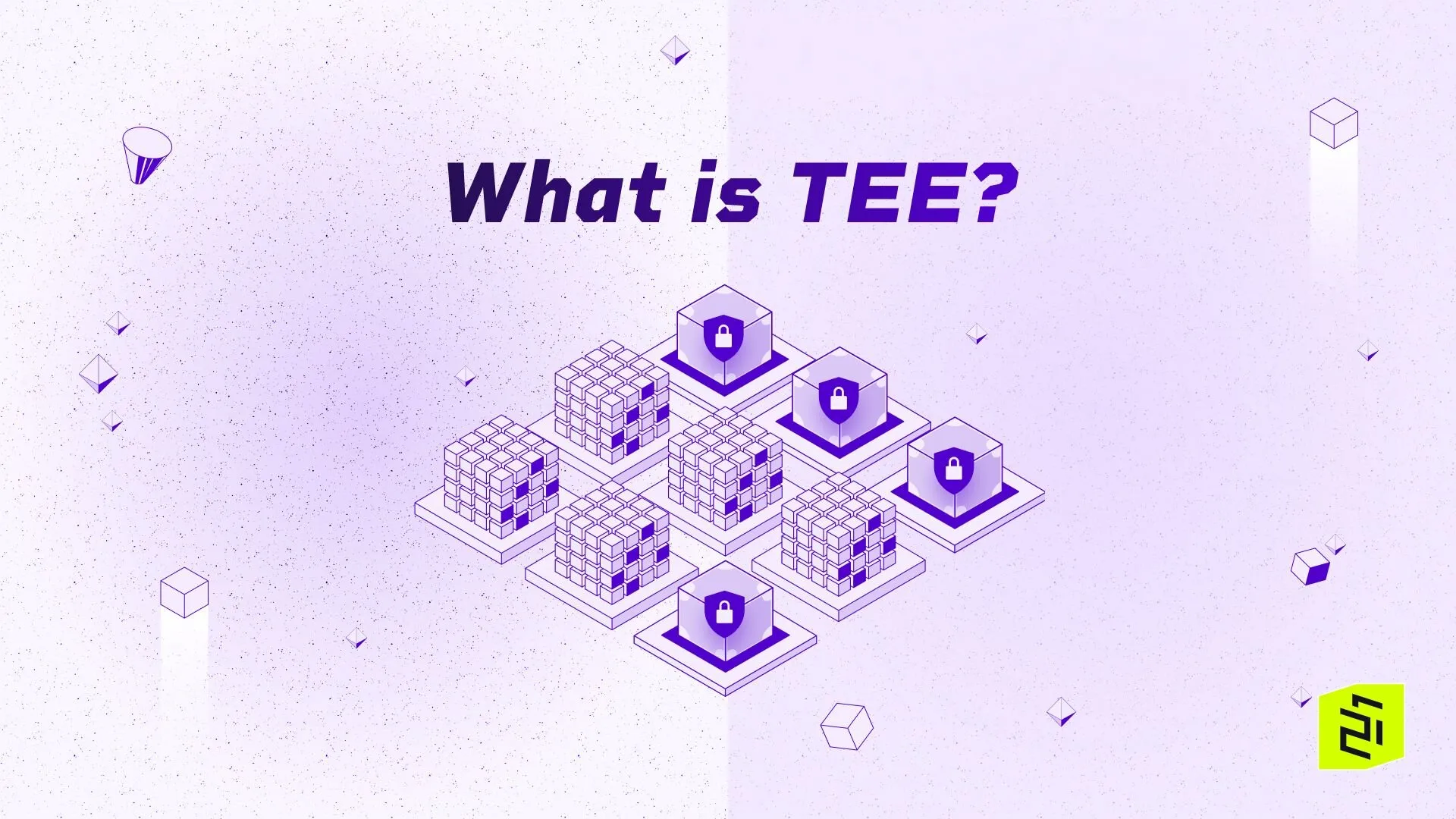
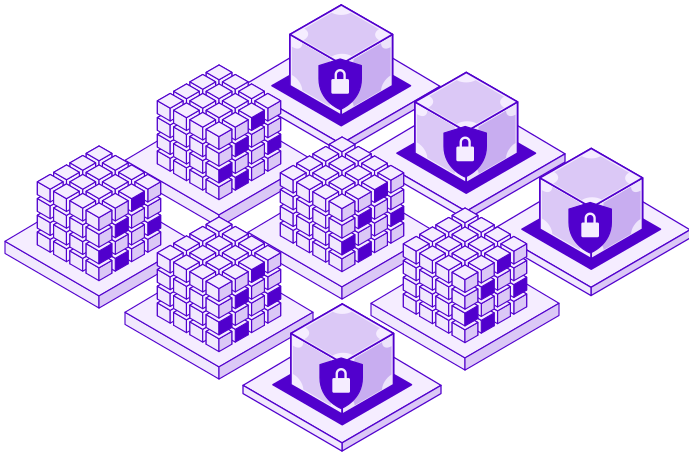
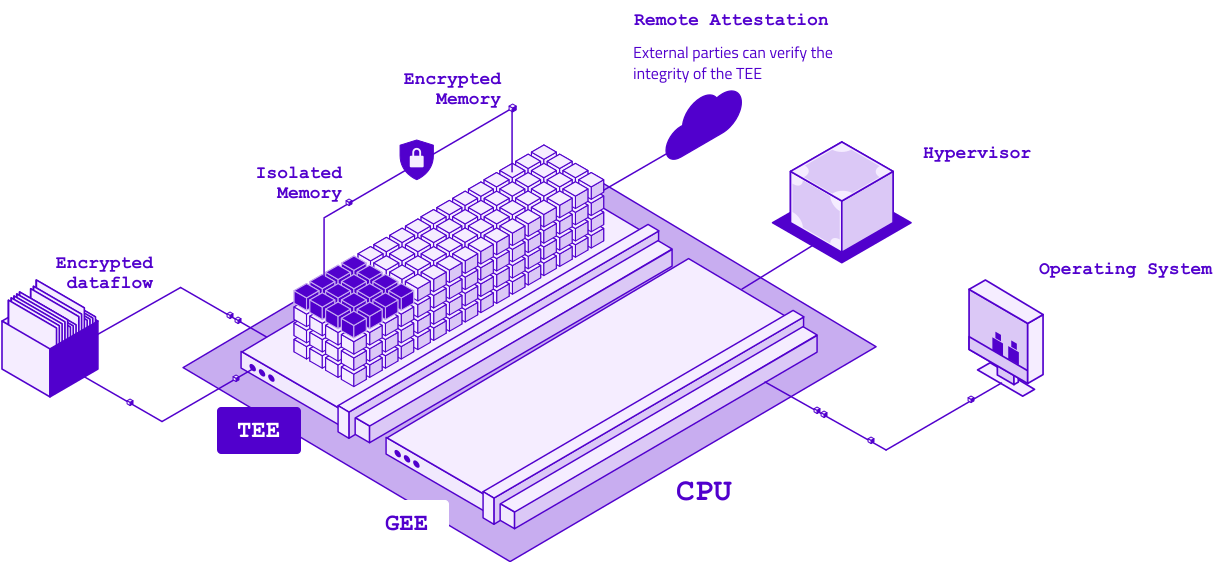
Trusted Execution Environments (TEEs) have emerged as a critical technology for safeguarding sensitive data and operations. TEEs are secure areas within a computing device’s processor where code can be executed in complete isolation from the rest of the system, providing a fortress of confidentiality, integrity, and attestation.
TEEs leverage advanced hardware features to create this secure enclave. For instance, technologies like ARM TrustZone and Intel SGX are pivotal in this space. ARM TrustZone divides the processor into “secure” and “normal” worlds, each running in isolation. Intel SGX, on the other hand, enables the creation of secure enclaves, where code and data are encrypted and can be processed securely. The process includes:
• Secure boot mechanisms to verify the integrity of the TEE software at startup.
Discover Secure Computing with aleph cloud
Dive into our docs and see how you can deploy AMD SEV-powered CVMs in minutes.
Despite their advantages, TEEs come with their set of challenges:
Aleph Cloud, a decentralized cloud infrastructure provider, integrates TEE principles into its services through the use of AMD SEV (Secure Encrypted Virtualization). This technology allows Aleph Cloud to offer Confidential Virtual Machines (CVMs) where:
Aleph Cloud’s implementation of TEE technology with AMD SEV is a testament to how TEE concepts can be applied to create secure, decentralized computing environments. This approach not only protects data while in use but also aligns with the growing trend towards privacy-preserving computations in cloud services, offering users a way to compute on private data without exposing it to potential threats.
Deploy Your Own Confidential VM
Follow our guide to set up secure, AMD SEV-powered Confidential Virtual Machines and protect your data.
Zero-Knowledge Proofs are cryptographic protocols that allow one party (the prover) to prove to another party (the verifier) that they know something or that some statement is true, without conveying any information apart from the fact that the statement is true. This concept is particularly useful when privacy is paramount:
While TEEs secure the execution environment, Zero-Knowledge Proofs (ZKPs) offer a different kind of security. ZKPs allow one party to prove to another that they know a value or that a statement is true without conveying any information apart from the fact that the statement is indeed true.
In essence, while both technologies aim at enhancing security and privacy, they operate in different spheres. TEEs focus on securing the environment in which data is processed, making it an excellent choice for computations that need to be kept secret from the host system itself. ZKPs, by contrast, excel in scenarios where the need to prove knowledge or validate computations without exposing data is crucial, thereby offering privacy at the data interaction level rather than the environmental level. Together, they can form a robust framework for secure, private computing across various applications.
The role of Trusted Execution Environments emerges as a cornerstone in the architecture of secure computing. TEEs offer a paradigm shift in how we approach data security, providing a hardware-backed assurance of privacy and integrity that traditional software solutions cannot match. They encapsulate sensitive operations within an impregnable vault, isolated from the broader, less secure computing environment. This isolation is crucial in an era where data breaches and cyber threats loom large, offering a sanctuary for our most critical computations and data storage.
TEEs are not just about security; they are about trust. They enable businesses, governments, and individuals to operate in environments where trust is not assumed but instead architecturally enforced through hardware. This trust extends to the execution of code where sensitive algorithms can run, financial transactions can be processed, or personal data can be analyzed without fear of exposure or tampering.
The integration of TEEs into services like Aleph Cloud’s** **decentralized cloud infrastructure, through technologies such as AMD SEV, highlights their versatility. It demonstrates how TEEs can serve as the foundation for new computing paradigms that are not only secure but also distributed, leveraging the benefits of blockchain and decentralized technologies. This convergence of TEEs with decentralized systems not only enhances security but also promotes a more resilient, censorship-resistant digital ecosystem.
Moreover, comparing TEEs with Zero-Knowledge Proofs (ZKPs) reveals the rich tapestry of tools available for privacy and security in computing. While TEEs shield the environment, ZKPs secure the information flow, together they weave a fabric of security that can adapt to a wide array of applications, from finance to health, from personal privacy to enterprise-level data protection.
TEEs will undoubtedly play a pivotal role in shaping the future of computing security. They promise to be instrumental in contexts where transparency, privacy, and security must coexist, enabling new forms of computation and data handling that were previously unthinkable due to security concerns. The development and adoption of TEEs signify a move towards a future where our digital lives can be lived with greater assurance, where the sanctity of our data and the integrity of our computations are upheld not just by policy or software but by the very hardware that powers our world.
Ready to Build Securely?
Implement Confidential Virtual Machines today and lead the way in privacy-first computing.
A TEE is a secure, hardware-isolated area within a processor that protects code and data from the rest of the system. It ensures that even the host operating system or server operator cannot access the contents of the enclave.
Confidential VMs use TEE technology (like AMD SEV) to encrypt the entire virtual machine's memory in hardware. This means your workloads and data remain encrypted even while being processed.
AMD Secure Encrypted Virtualization (SEV) encrypts each VM's memory with a unique key managed by a dedicated security processor. The hypervisor and other VMs cannot read the encrypted memory.
TEEs protect computation using hardware isolation — code runs in an encrypted enclave. Zero-knowledge proofs are cryptographic methods that prove a computation was done correctly without revealing the input data. They solve different problems and can be complementary.
In blockchain, TEEs enable confidential smart contracts, private transaction processing, secure oracle feeds, and verifiable off-chain computation. Aleph Cloud uses TEEs to provide confidential VMs for running sensitive Web3 workloads.
Confidential computing protects data while it's being processed, not just at rest or in transit. Using hardware-based TEEs like AMD SEV, it ensures that sensitive workloads remain encrypted in memory, even from the cloud infrastructure operator.
Payments
Deploy a decentralized VM in 10 minutes with Aleph Cloud's Rust CLI. Install, fund with USDC/ALEPH, launch Ubuntu instances for ~$10/month, and SSH in. No Python, no centralized cloud.
Computing
Aleph tokenomics introduces a dual-stream rewards model for decentralized cloud operators: a transitional reward floor plus a usage-based revenue share.
Payments
Pay As You Go and Holder Tier payments are officially deprecated. Aleph Cloud now runs on a single credit system. Top up with USDC, fiat, or ALEPH and pay for what you use.
Virtual Machines
Explore how OpenClaw AI agents, and Aleph Cloud’s decentralized AI Supercloud are redefining autonomous computing with sovereign, censorship-resistant infrastructure.